
For many people, the very name of this article brings back memories of childhood books. The ‘Choose Your Own Adventure’ series was hugely popular in the 80s and 90s, with more than 250 million copies sold. If you never read them, the books were written in a way that placed you, the reader, in the role of the protagonist, where you were required to make choices throughout the story. Each decision led you to a different page to continue your journey, and you would keep making choices until you reached one of the many possible endings.
The catch with the ‘Choose Your Own Adventure’ books was that not all endings were happy ones. Sometimes you would end up in an endless loop, making the “wrong” choice and being sent back to the same pages over and over again, doomed to repeat the story forever. Other times, your character didn’t survive or simply didn’t live happily ever after.
With that little refresher out of the way, I thought it might be interesting to take the idea of a Choose Your Own Adventure story and apply it to the process of creating a retirement plan in Canada. Read on and see what choices you would make.
In this article:
- Our Story Begins
- Step #1 – Figuring Out What Your Goals Are
- Step #2 – Where to Invest
- Step #3 – Efficiency in Your Plan
- Step #4 – Staying on Track
- The End of the Adventure!
Our Story Begins
Picture yourself as a typical Canadian. You have your hockey skates on, you’re holding the door for someone walking into the building behind you, and you have an ice-cold beverage in your hand while sitting on a dock, listening to the haunting call of the loon. Can you see it? Good.
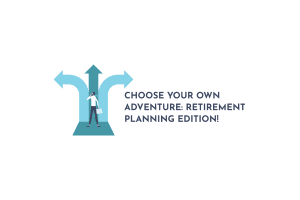
Now imagine that you’re early in your working years and realize that you’d like to retire from work someday. As you think it over, you come to the realization that you need a plan to help you get there. This leads you to a choice… do you:
- Try and figure it out on your own
OR - Decide to find a financial advisor to work with to help you?
Whichever path you choose, it’s important to understand what lies ahead. So, let’s take a look at the options and see which one makes the most sense for you.
Retirement Planning Step #1 – Figuring Out What Your Goals Are
This seems like the logical first step. If you’re going on vacation, you need to know where you want to go before you can start planning your trip. The same idea applies to retirement. You need to understand where you want to end up before you can figure out how to achieve that goal. This means you now have two options, depending on the choice you made to begin with.
- If you selected option A, you are on the DIY path. This likely means you’ll be using Google to ask questions such as “How much do I need to retire in Canada?” and searching for calculators that can help you project what you have today into the future. With these answers, you can start to determine what path you’re currently on and whether it will lead you to your goal.
- If you went with option B, you will sit down with a financial advisor who will talk with you to better understand your goals and the path you are currently on. Do you want to travel? What is important to you? Do you want to leave a legacy? All of this information will help your advisor create a customized financial plan tailored to your unique circumstances.
Either path is viable and can lead to successfully setting your goals for the future. The difference lies in how you achieve this. The DIY path requires a working knowledge of concepts such as inflation, the time value of money, and complex financial calculations. Working with an advisor allows you to focus more on the “what you want” aspect of your goals while letting someone else handle the “how to make it happen” part of the plan.

Retirement Planning Step #2 – Where to Invest
Once your goals are set, the next step is to determine how to implement your plan. To do this, you need to decide where to invest your savings to maximize your chances of achieving those goals. There are many options available. Should you use a TFSA? An RRSP? Should you invest in mutual funds, managed ETFs, or individual stocks? Let’s take a closer look at what each option could mean for your path.
- Choosing option A means you will need to research the best options for yourself. You might turn to Google for help, or perhaps (though it’s not recommended) rely on a finfluencer on TikTok who shares information you believe will help you build your portfolio. You will also need to stay on top of things regularly, as what makes sense today may not make sense tomorrow. When managing your own portfolio, it’s important to ensure it evolves to reflect any changes that occur in your life.
- Option B followers work with an advisor who uses their expertise to create a customized portfolio. The advisor will consider factors such as current and future tax efficiency, individual risk tolerance, and time horizons to build and maintain a portfolio that aligns with your goals and lifestyle. They will also ensure that as your life changes, your portfolio is adjusted accordingly to keep you on track.
Additionally, there is one important thing to consider: what happens when the markets hit a rough patch? If you are on the DIY path, you need to be careful not to make reactionary moves during market downturns simply because you feel like you need to do something. One of the greatest benefits of working with an advisor is their ability to stay calm during market dips, understanding that these fluctuations are already accounted for in your original plan, and helping you avoid making poor decisions based on emotion.
Retirement Planning Step #3 – Efficiency in Your Plan
This applies to a few key areas of your plan: taxation and accessing government retirement benefits. The first involves ensuring that, while you are saving, you do so in the most tax-efficient way possible that still supports your goals. The second area where efficiency becomes crucial is during your income-drawing years (after you’ve retired). It’s important to have the right mix of income sources to maximize all available funds, including government benefits, as this is essential to the long-term success of your plan.
- If you are still following the DIY plan, you need to understand how RRSPs, RRIFs, TFSAs, and any workplace savings plans you have (such as RPPs, LIRAs, or LIFs) will work together with CPP, OAS, and any taxable non-registered investments (for example, capital gains). Each component in this mix has a different tax treatment, and making an error by relying too heavily on one can lead to missed opportunities or reduced income.
- Option B investors work with an advisor who creates a plan focused on tax efficiency, understanding how taxes can erode savings over time. They will look for ways to minimize taxes and Old Age Security clawbacks during retirement while maintaining the greatest possible tax advantages throughout your working years.

Retirement Planning Step #4 – Staying on Track
Have you ever heard of a concept called “risk creep”? It is easiest to explain this idea with an example. If you build a DIY portfolio and your risk tolerance suggests you should hold 60% in equity investments and 40% in fixed income, you can set that up on day one with those ratios. However, one of these categories will almost always grow faster than the other. If the equity markets perform well and their growth outpaces that of fixed income, your 60/40 mix may shift to something like 70% equity and 30% fixed income. This means your portfolio now carries more risk than you are comfortable with simply because of how the markets move.
- For the DIY plan builder who chose option A, it is important to review your investments regularly and make adjustments to keep your portfolio aligned with your risk tolerance. It is your responsibility to place trade instructions and ensure that everything returns to the mix that matches your comfort level with risk.
- When option B is selected, you have an advisor who can rebalance your portfolio on a preset schedule, helping you stay within your preferred risk tolerance. This removes the responsibility from you and, as you will see shortly, helps eliminate the influence of emotional decisions that can work against your long-term plans.
Why is this important? Consider this: it won’t always be that one portion of the portfolio grows faster than the other. Sometimes one will shrink faster instead. If your equities decrease in value and your mix shifts from the original 60/40 to 50/50, there is now less risk in the portfolio than intended. Human nature being what it is, it can be very difficult, when managing your own portfolio, to move money from fixed income (a safe haven) into equities that are losing value. Psychologically, it feels counterintuitive to take money from a stable investment and put it into something that is declining. However, this step is essential. Maintaining the proper asset allocation makes achieving your long-term goals much more realistic. It can simply be hard to make yourself do it. An advisor, on the other hand, does not have the same emotional attachments and can make more objective, plan-focused decisions.
The End of the Adventure!
Remember when I mentioned that one of the interesting things about the ‘Choose Your Own Adventure’ books was that not all of the endings were happy? The same applies to retirement planning. There is no option that guarantees success in every scenario. What I can say with certainty is that when deciding which path to take, you should carefully weigh a few key factors.
If you choose the DIY route, you must be willing to learn the details of various investment products and strategies. You also need to understand the tax implications of different investments and, most importantly, be able to act rationally in emotional situations when it feels difficult to do what you know is right.
If you choose option B and decide to work with an advisor, you gain the expertise and experience of someone who can help guide you through the retirement planning process. While you might pay slightly lower fees by managing everything yourself, only you can decide if the time and effort are worth it.
If you would like to speak with an advisor and see whether their services are a good fit for you, reach out to the team at Strata Wealth & Risk Management. You will not regret it.